A year of noticing, for women in the Southern Hemisphere
The Southern Moon Calendar 2027 is a year of noticing: the moon over your backyard, the signs of your own cycle, and simple rites made from what's already around you. Day by day, you come to know your own rhythm, and to trust it.
Order the calendar
Pre-orders are open
Pre-orders are taken in two rounds.
- Round 1: order by Monday 30 November. Your calendar arrives before the new year.
- Round 2: order by Monday 7 December. It should arrive before the new year.
- Pick it up from The Gathering Space, Shop 2, 160 Flinders Street, Paddington NSW 2021, on launch day, Thursday 10 December, 12–6pm. Or have it posted.
From Thursday 10 December the calendar is also on sale at The Gathering Space.
$48.99. Posting within Australia.
Order the calendarWhat the calendar is for
The Southern Moon Calendar is a place to keep track of three things through the year: the moon, the seasons and your menstrual cycle.
Everything in it is set to the Southern Hemisphere. The turning points of the year fall in the months they happen here, so the winter solstice is in June and the summer solstice is in December. Moon times are calculated for Sydney, with every Australian state listed.
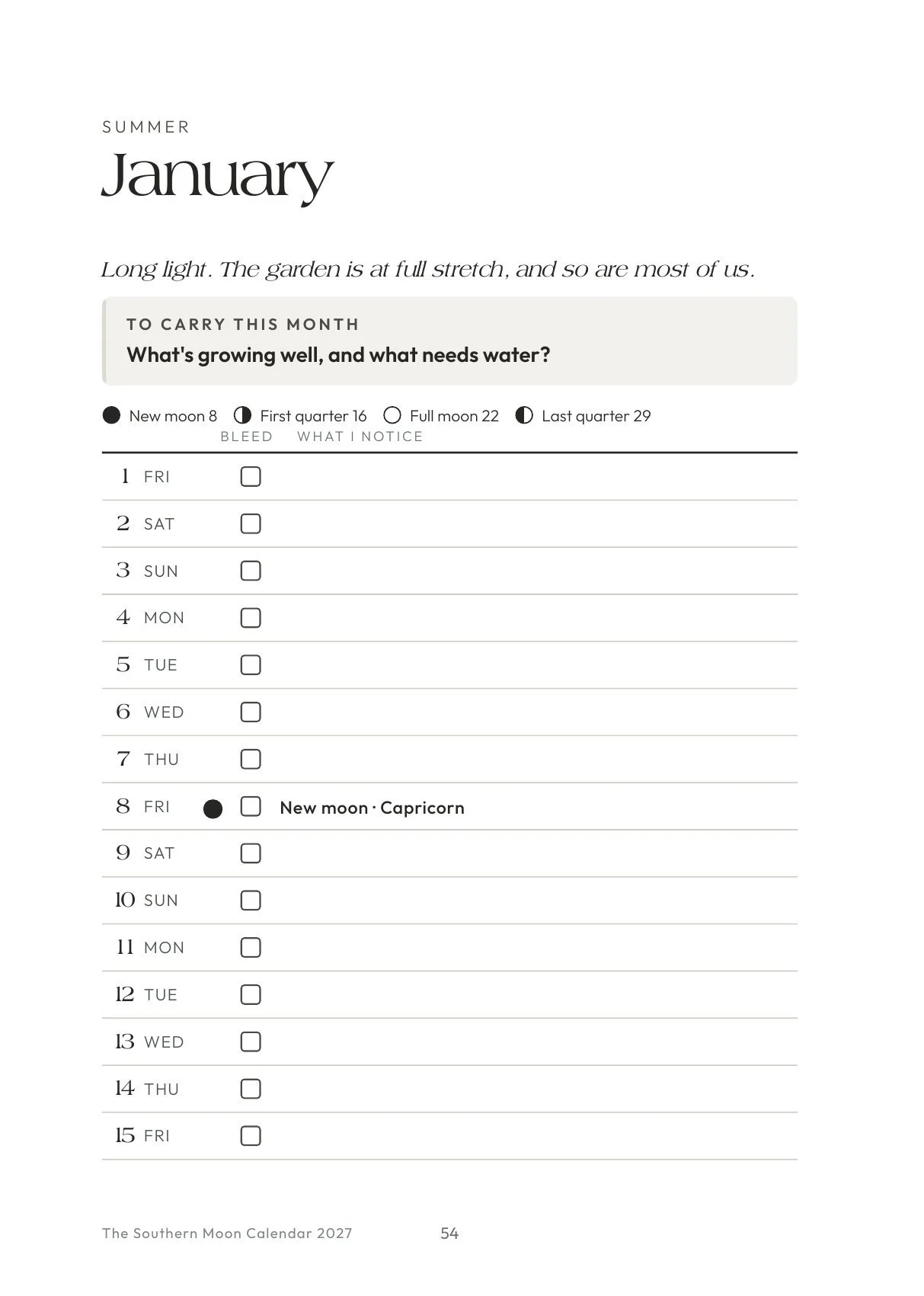
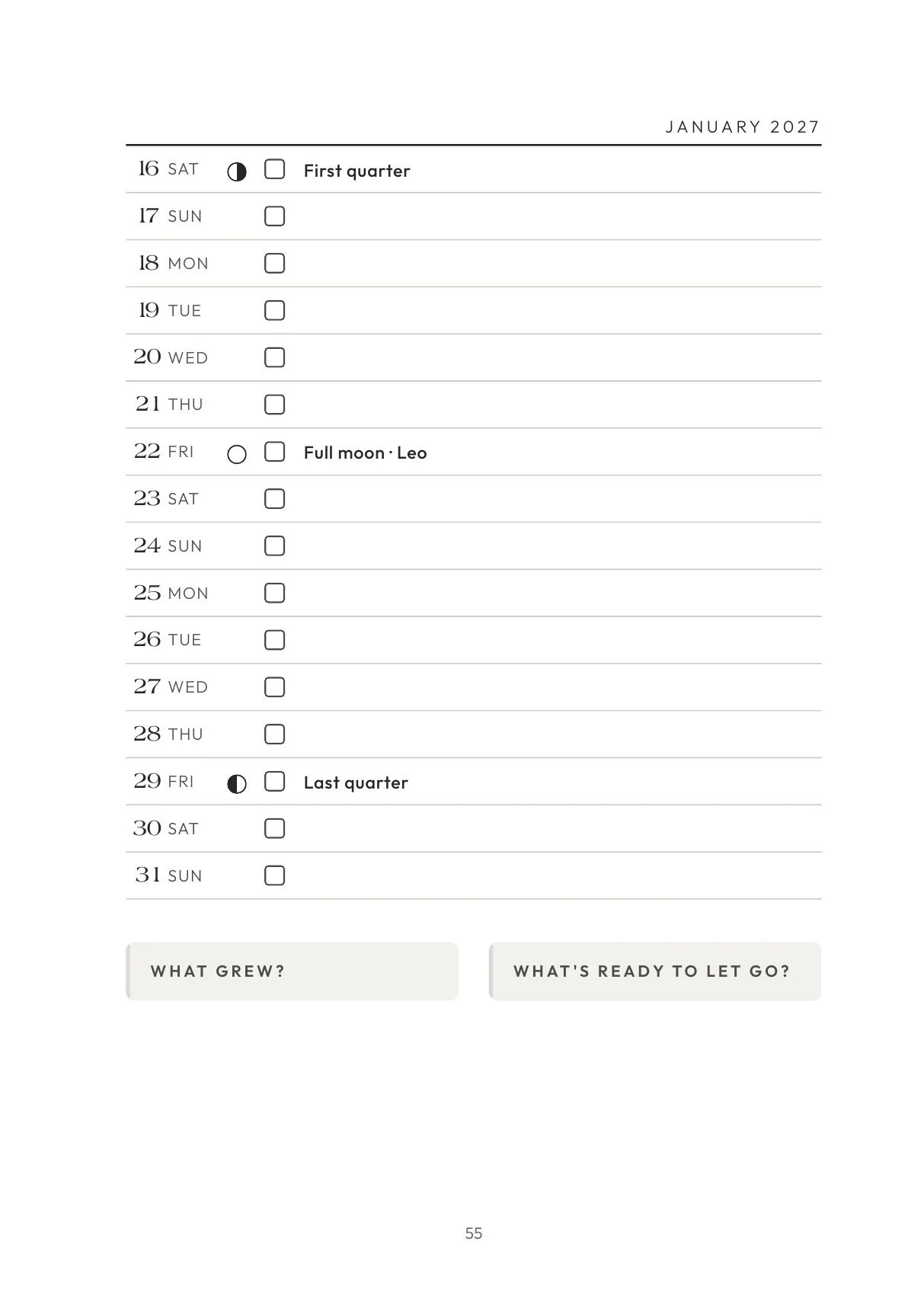
Each day has a line to write a word or two, and a box to tick if you're bleeding. Over a few months you start to see your own pattern: the days you have more energy, the days you need rest, and how that lines up with your cycle and the moon.
For each turning point of the year there are simple practices you can do at home, using things you already have in the kitchen or the garden.
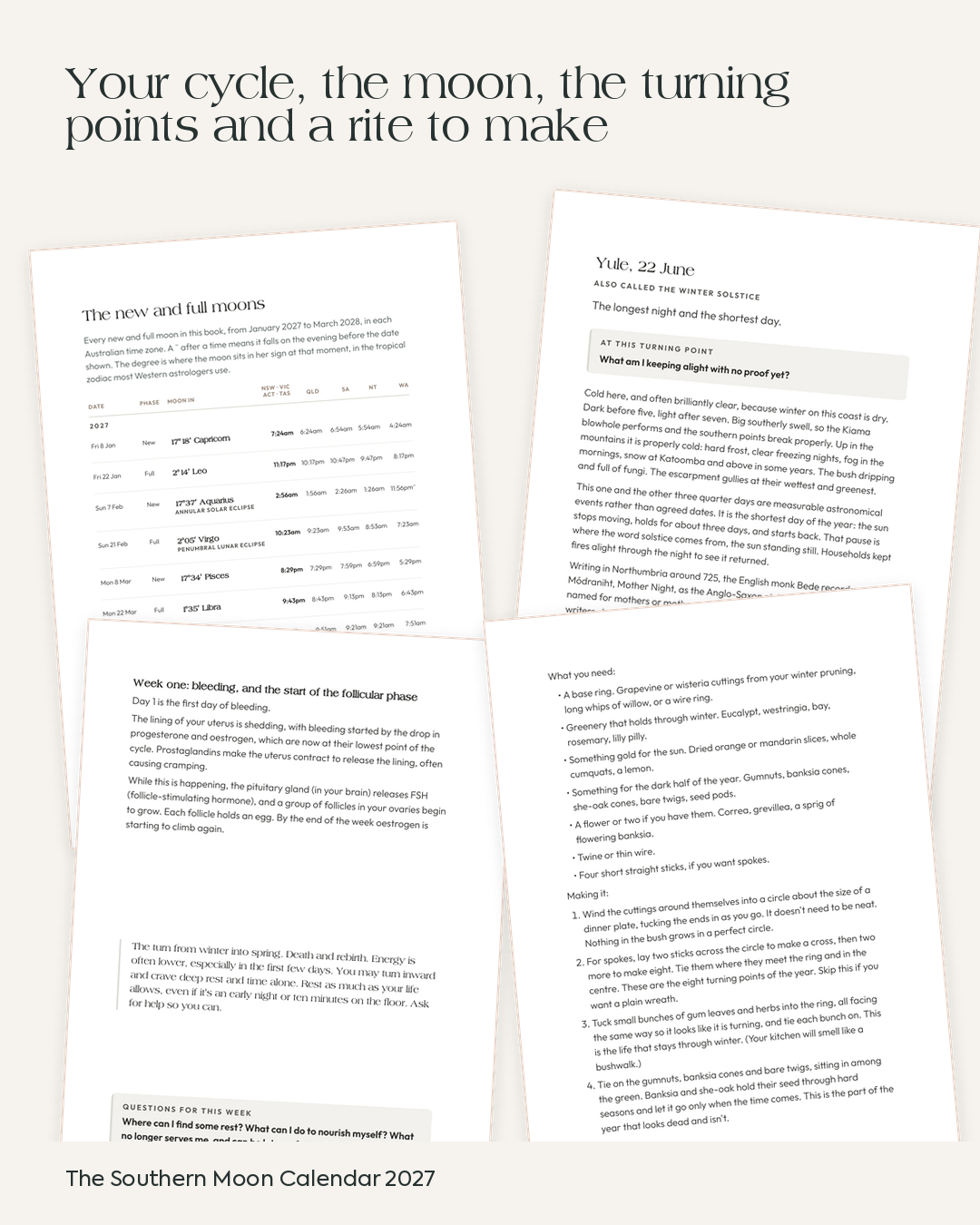
What's inside
- Fifteen months, January 2027 to March 2028. A double page for each month, a line for every day, and a box to tick when you bleed.
- The moon, set to our sky. Every new and full moon, sign and eclipse, calculated for Sydney, with times for every Australian state.
- Your cycle, week by week. What's happening in your body, and what it can feel like.
- The southern wheel of the year. The eight turning points in their southern months, marked on both their traditional and solar dates.
- Rites made from what you have. Practices for each turning point using the kitchen, the garden and the walk home.
- Questions to carry. A prompt for each month and each season. Take what's useful and leave the rest.
How to use it
- Pay attention to the changes in the moon, in the seasons, in yourself.
- Write a word or two, and tick the days you bleed.
- Read it back a year on.
Miss days and the pattern still shows.
The calendar runs to March 2028
Summer is a busy time to begin anything. School holidays, children home, work winding down and then starting again at a run.
So the calendar runs to March 2028. Open it on 1 January, or in February, or in March. Start any time up to April and there are still twelve full months of pages ahead of you.
It also means Lughnasadh (1 February) and Mabon (20 March) come round twice, a year apart, so you can compare what you wrote the first time.
About me
I'm Jennifer Hazi, a Registered and Endorsed Midwife and a mother of five daughters. I teach women's cycle work at The Gathering Space in Paddington. Much of what's in this calendar I learned from Jane Hardwicke Collings and the School of Shamanic Womancraft, and this is me passing it on in my own words.
I wrote it for my daughters, Batya, Sora, Hannah, Kiki and Shifra, the women I sit with, who wanted something set to our sky and our seasons, and for you, the woman who knows there is more and is looking for the path back to her own intuitive, wonderful self.
After a year of noticing
You'll know which days ask the most of you and which ones want rest. You'll know when you're outward and bright. You'll have a few simple practices of your own, using what you have at home.
What you've made is a map of you. It will be more accurate than anything anyone else could hand you.
You might like this if
- you want to understand your own cycle, through your own notes
- you live in the Southern Hemisphere and want the wheel of the year to match your weather
- you'd like ritual that uses what's already in your house and garden
- you tend to start the year in February, once the holidays settle
- you're looking for a gift for a woman who notices things
Questions about the calendar
- Does it still work if I'm not bleeding right now?
- Yes. If you're pregnant, breastfeeding, on hormonal contraception or past menopause, the moon takes the place of your cycle. The book explains how.
- Do I need to know astrology?
- No. The signs are there if you want them.
- Can I start in February or March?
- Yes. That's why the calendar runs to March 2028. Start any time up to April and you still have twelve full months of pages.
- Is this medical advice?
- No. It's for noticing. If something about your cycle worries you, talk to your GP, midwife or another health practitioner you trust.
- Where do you post to?
- Anywhere in Australia. Postage is $12 for one copy, and $2.50 for each extra copy, up to five. For more than five, email me at hello@jenniferhazi.com.au and I'll work out the postage.
The southern moons of 2027
Every new and full moon of the year, with her sign, for every Australian time zone. A free printable, by email.
What the calendar is for
The Southern Moon Calendar is a place to keep track of three things through the year: the moon, the seasons and your menstrual cycle.
Everything in it is set to the Southern Hemisphere. The turning points of the year fall in the months they happen here, so the winter solstice is in June and the summer solstice is in December. Moon times are calculated for Sydney, with every Australian state listed.
Each day has a line to write a word or two, and a box to tick if you're bleeding. Over a few months you start to see your own pattern: the days you have more energy, the days you need rest, and how that lines up with your cycle and the moon.
For each turning point of the year there are simple practices you can do at home, using things you already have in the kitchen or the garden.
What's inside
- Fifteen months, January 2027 to March 2028. A double page for each month, a line for every day, and a box to tick when you bleed.
- The moon, set to our sky. Every new and full moon, sign and eclipse, calculated for Sydney, with times for every Australian state.
- Your cycle, week by week. What's happening in your body, and what it can feel like.
- The southern wheel of the year. The eight turning points in their southern months, marked on both their traditional and solar dates.
- Rites made from what you have. Practices for each turning point using the kitchen, the garden and the walk home.
- Questions to carry. A prompt for each month and each season. Take what's useful and leave the rest.
How to use it
- Pay attention to the changes in the moon, in the seasons, in yourself.
- Write a word or two, and tick the days you bleed.
- Read it back a year on.
Miss days and the pattern still shows.
The calendar runs to March 2028
Summer is a busy time to begin anything. School holidays, children home, work winding down and then starting again at a run.
So the calendar runs to March 2028. Open it on 1 January, or in February, or in March. Start any time up to April and there are still twelve full months of pages ahead of you.
It also means Lughnasadh (1 February) and Mabon (20 March) come round twice, a year apart, so you can compare what you wrote the first time.
About me
I'm Jennifer Hazi, a Registered and Endorsed Midwife and a mother of five daughters. I teach women's cycle work at The Gathering Space in Paddington. Much of what's in this calendar I learned from Jane Hardwicke Collings and the School of Shamanic Womancraft, and this is me passing it on in my own words.
I wrote it for my daughters, Batya, Sora, Hannah, Kiki and Shifra, the women I sit with, who wanted something set to our sky and our seasons, and for you, the woman who knows there is more and is looking for the path back to her own intuitive, wonderful self.
After a year of noticing
You'll know which days ask the most of you and which ones want rest. You'll know when you're outward and bright. You'll have a few simple practices of your own, using what you have at home.
What you've made is a map of you. It will be more accurate than anything anyone else could hand you.
You might like this if
- you want to understand your own cycle, through your own notes
- you live in the Southern Hemisphere and want the wheel of the year to match your weather
- you'd like ritual that uses what's already in your house and garden
- you tend to start the year in February, once the holidays settle
- you're looking for a gift for a woman who notices things
Questions about the calendar
- Does it still work if I'm not bleeding right now?
- Yes. If you're pregnant, breastfeeding, on hormonal contraception or past menopause, the moon takes the place of your cycle. The book explains how.
- Do I need to know astrology?
- No. The signs are there if you want them.
- Can I start in February or March?
- Yes. That's why the calendar runs to March 2028. Start any time up to April and you still have twelve full months of pages.
- Is this medical advice?
- No. It's for noticing. If something about your cycle worries you, talk to your GP, midwife or another health practitioner you trust.
- Where do you post to?
- Anywhere in Australia. Postage is $12 for one copy, and $2.50 for each extra copy, up to five. For more than five, email me at hello@jenniferhazi.com.au and I'll work out the postage.
The southern moons of 2027
Every new and full moon of the year, with her sign, for every Australian time zone. A free printable, by email.
I live and work on the lands of the Gadigal people of the Eora Nation and the Darug people of the Blue Mountains. I pay my respects to their Elders past, present and emerging.
This calendar is for reflection and general interest. It is not medical advice.